Why Your Own Work Always Looks Smaller Than Everyone Else's
The Feed Is Not a Fair Witness
Let's start with the obvious thing nobody wants to say out loud: your Instagram feed, your TikTok For You page, your Pinterest boards — none of them are showing you reality. They're showing you a curated highlight reel of other people's best moments, filtered through an algorithm that rewards polish, confidence, and the particular kind of beauty that photographs well.
You, meanwhile, are watching your own work from the inside. You see the 11 p.m. panic sessions, the versions that didn't work, the ideas that felt electric in your head and landed flat on the page. You see the whole messy process. They just see your finished piece — and somehow even that doesn't look as good to you as their finished piece looks.
This isn't a personal failing. It's a structural problem. And once you understand the structure, you can stop taking it so personally.
The Psychological Trick Your Brain Is Pulling on You
Psychologists have a term for this — it's called the better-than-average effect when it works in your favor, and something closer to imposter syndrome or self-discrepancy theory when it works against you. For a lot of creative people, the brain does something particularly cruel: it applies the harshest critical standards to the work closest to home.
Think about it. When you look at a stranger's painting, you're a viewer. You bring generosity, curiosity, an open eye. When you look at your own painting, you're the creator — you know every compromise you made, every place you settled, every moment you thought this isn't quite right and kept going anyway.
So you're not actually comparing your work to their work. You're comparing your behind-the-scenes to their highlight reel. That's not a fair fight. That's never going to be a fair fight.
The Overnight Success Myth Does Real Damage
Social media has a particular obsession with the breakout moment — the post that went viral, the artist who blew up seemingly out of nowhere, the creator who landed a major deal after posting one video. What those stories almost never include is the five, ten, fifteen years of work that happened before that moment.
When you see someone's success without context, your brain fills in the gap with a story that goes something like: they just had it, and I don't. It's a narrative that's almost always wrong, but it's the one we default to because it's simpler than the real version.
The real version usually involves years of work that nobody saw, a lot of failure that didn't make it into the brand story, and a combination of skill-building and timing that looked like luck from the outside. None of that fits in a caption.
When you measure your Chapter 3 against someone else's Chapter 12, you're going to feel behind. Every time.
How to Build an Honest Relationship With Your Own Work
So what do you actually do about this? A few things that work better than just telling yourself to stop comparing (which, as advice goes, is about as useful as telling someone to just relax).
Keep a running archive of your own work. Not a portfolio — an archive. Include the messy stuff, the experiments, the pieces you'd never show anyone. The goal isn't to publish it; it's to give yourself a real timeline of your growth that isn't filtered through external validation. When you can literally see where you were six months ago versus today, the story your brain tells about your progress gets harder to distort.
Separate consumption time from creation time. This sounds simple, but it's genuinely hard to do in practice. If you're scrolling other people's work while you're in the middle of your own creative process, you're inviting the comparison trap in at the worst possible moment. Treat them as different activities that happen at different times.
Find your own metrics. External validation metrics — likes, followers, shares, downloads — are real, and they matter for certain practical things. But they're terrible measures of creative growth. What are the things only you can measure? How quickly you solve a problem you've struggled with before. Whether a piece feels more like you than the last one did. Whether you're taking risks you weren't willing to take a year ago. Those are the numbers worth tracking.
Get honest feedback from people who know your work. Not strangers on the internet, not your mom — people who understand what you're trying to do and can tell you whether you're getting closer to it. A trusted creative community is one of the best antidotes to the distorted perception problem, because it gives you a mirror that actually reflects something true.
The Thing About Visibility
Here's something the algorithm doesn't tell you: visibility and quality are not the same thing. Some of the most technically accomplished work in any medium gets very little traction online, because it doesn't photograph well, or it doesn't fit a trend, or it's aimed at an audience that isn't particularly online. Some work that spreads everywhere is genuinely great. Some of it is just optimized for spreading.
When you use algorithmic visibility as a proxy for creative worth, you're letting a machine that was built to maximize engagement — not artistic value — make judgments about your work. That's a strange thing to hand that kind of power to.
Your work's reach and your work's quality are two separate conversations. They can overlap, but they don't have to. Keeping them separate in your own mind is one of the more useful things you can do for your long-term creative health.
You're Closer Than You Think
Here's the part that's easy to miss when you're deep in the comparison spiral: the fact that you can see the gap between where you are and where you want to be is actually a sign of creative maturity. You can't perceive a gap you don't understand. The dissatisfaction you feel about your work is partly evidence of how much your taste has grown.
That doesn't make the gap comfortable. But it does mean you're not as far behind as you think — you're just far enough along to know what good looks like.
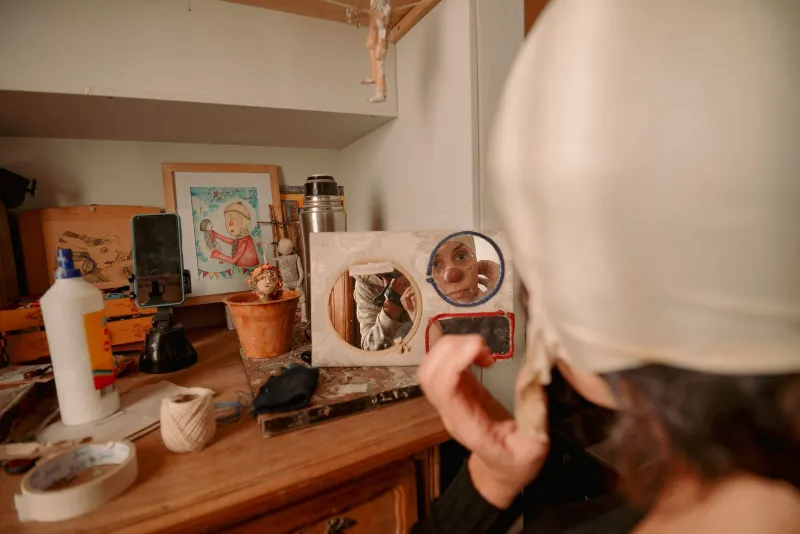
The mirror isn't broken. It's just showing you the wrong room. The one worth looking at is the one with your work in it, your timeline on the wall, and nobody else's highlight reel on the screen.