Why the 'Messy' Creatives in Your Life Are Onto Something You're Not
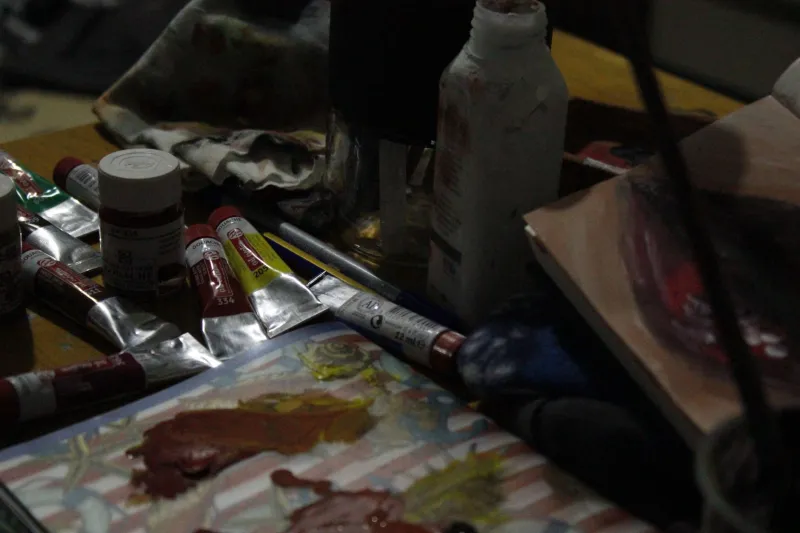
Let's talk about your most creative friend. You know the one. Their studio looks like a paper recycling center had a disagreement with a paint supply store. Their calendar is more suggestion than schedule. They miss deadlines occasionally, lose receipts constantly, and have a desktop folder literally titled "stuff." And yet — somehow, annoyingly — they keep making the most interesting work in the room.
You've probably chalked this up to personality. A quirk. The acceptable tax on talent. But what if the mess isn't incidental to the creativity? What if it's actually part of the mechanism?
The Brain Doesn't Like Straight Lines
Here's the thing about how creative thinking actually works: it's not linear. The neuroscience on this has been building for years, and the picture it paints looks nothing like a color-coded planner. The default mode network — the part of your brain that lights up during daydreaming, free association, and those random shower thoughts that turn into your best ideas — is actively suppressed when you're in high-focus, task-completion mode.
In other words, the same mental state that lets you crush a to-do list is the one that shuts down your most generative thinking.
Rigid organization, back-to-back scheduling, and obsessive task-tracking all signal to your brain: stay in execution mode. Which is great if you're processing invoices. Not so great if you're trying to figure out what your next series of paintings is actually about.
Disorder, on the other hand, introduces something psychologists call "environmental complexity." When your surroundings aren't perfectly controlled, your brain stays slightly alert — scanning, making unexpected connections, noticing things. That stack of unread magazines next to your coffee mug? Your eye catching a headline while you're thinking about something else? That's not distraction. That's cross-pollination.
Productivity Culture Has a Creativity Problem
American hustle culture has a particular obsession with optimization. The self-help section of any Barnes & Noble is basically a monument to the belief that if you just systematize your morning routine hard enough, success will follow. And look — some of that stuff is genuinely useful for certain kinds of work.
But creative work isn't "certain kinds of work." It's its own thing. And a lot of artists have quietly burned out not from laziness or lack of discipline, but from trying to force their process into a framework built for a fundamentally different kind of output.
The problem with applying corporate productivity logic to creative careers is that it mistakes visible busyness for actual progress. An artist spending three hours staring out a window, mentally turning a concept over and over, is working. A graphic designer who looks like they're doing nothing while a solution quietly assembles itself in the back of their mind is working. But neither of those things looks productive on a time-tracking app.
When creatives internalize the message that they're failing because they can't maintain a tidy system, they often start spending more energy managing the appearance of productivity than actually making things. That's the real drain.
Mess as Creative Protection
There's a subtler argument here too, and it has to do with creative identity.
When your workspace is deeply, personally chaotic — when it reflects your actual process rather than some aspirational version of it — it becomes harder for outside forces to colonize. A perfectly organized, neutral workspace is also a workspace that could belong to anyone. A chaotic one, full of half-started sketches and reference images and that weird object you picked up at a flea market because it felt important somehow, is yours. It holds your thinking.
Several artists and designers have described their cluttered studios as a kind of external memory — a physical record of where their brain has been. Cleaning it up, they say, often means losing threads. Reorganizing means re-linearizing a process that was never linear to begin with.
This isn't an excuse to live in squalor. It's an argument for being honest about what your process actually needs, rather than what productivity culture tells you it should need.
So What Do You Do With This?
If you're a creative professional who's been beating yourself up for not being more organized, here's a gentler reframe: maybe the goal isn't to get your chaos under control. Maybe it's to understand which parts of your chaos are actually doing useful work.
Some questions worth sitting with:
- Where do your best ideas actually come from? If it's the shower, the drive, the weird hour before you've fully woken up — that's your default mode network doing its thing. Are you giving it enough space?
- What does your workspace actually need? There's a difference between chaos that energizes and chaos that just stresses you out. Not all mess is creative mess.
- Which productivity systems are helping and which are performing? If you're maintaining a system mostly because it looks good on Instagram or impresses clients, that's worth noticing.
Your most creative friends probably haven't figured out some secret. They've just — maybe accidentally, maybe instinctively — stopped apologizing for the way their brain actually works. That's not a small thing. In a culture that's constantly trying to sand down the edges of creative thinking into something more manageable and monetizable, refusing to optimize yourself into blandness might be the most radical move available.
The mess, it turns out, might be the point.