Two Voices, One Vision: How Creative Partnerships Actually Make Your Work More You
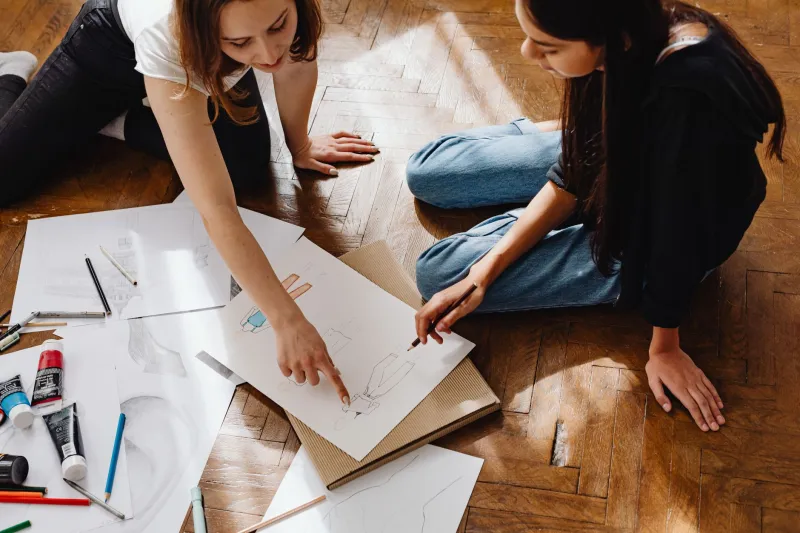
There's a particular kind of anxiety that lives in the chest of almost every independent creative. You've spent years — sometimes a decade or more — carving out a voice that feels genuinely yours. A way of seeing the world that's specific enough to be recognizable and personal enough to matter. So when someone suggests a collaboration, the gut response isn't excitement. It's something closer to suspicion.
What if I lose the thread?
What if their ideas drown mine out?
What if the final thing looks like neither of us — just a compromise dressed up as art?
These aren't irrational fears. They're actually pretty logical conclusions if you think of collaboration as addition — two separate visions mashed together until something survives. But that framing is exactly where creatives go wrong.
The Myth of the Lone Creative Genius
American culture has a complicated relationship with the solo artist. We love the mythology of it — the writer alone in a cabin, the painter in a Brooklyn loft, the musician recording demos at 2 a.m. with a borrowed mic. There's romance in the singular vision. And to be fair, that solitude is real and necessary for a lot of creative work.
But here's what gets quietly edited out of those stories: almost none of the work we consider iconic was made in complete isolation. Toni Morrison had editors who pushed her. Ira Glass has always worked with a team. Even the artists who seem most intensely personal — the ones whose work feels like reading someone's diary — usually have a collaborator somewhere in the chain who asked the right question at the right moment.
The myth of the lone genius isn't just inaccurate. It's actually holding a lot of talented people back from work they couldn't make any other way.
What Collaboration Actually Does to Your Identity
Here's the paradox worth sitting with: working closely with another creative doesn't dilute your voice. It often reveals parts of it you didn't know existed.
Think about how you explain your own work to someone who doesn't already understand it. You have to get specific. You have to articulate choices you usually make on instinct. That process — of translating your internal logic into language another person can engage with — is one of the fastest ways to understand what you actually believe about your own practice.
A good collaborator isn't a threat to your vision. They're a mirror. And sometimes what you see in that mirror surprises you in the best possible way.
Illustrator and art director duo Genevieve and Teagan (a composite of real creative partnerships you'll recognize if you follow the indie publishing world) spent two years insisting they couldn't work together because their aesthetics were too different. Genevieve's work was loose and organic; Teagan's was architectural and precise. When they finally tried a small joint project — a limited zine series — something unexpected happened. The tension between their styles became the point. The work was more interesting because of the friction, not in spite of it.
Neither of them could have made it alone. And neither of them felt erased in the final product.
The Three Things That Actually Protect Your Creative Integrity in a Partnership
So if collaboration can be this generative, why does it go wrong so often? Usually, it comes down to skipping three foundational conversations before the work even starts.
1. Define what's non-negotiable — for real.
Not everything about your process is precious. Some of it is habit, some of it is comfort, and some of it actually matters deeply to the work. Before you start a collaboration, spend some time sorting those into separate piles. What would you genuinely fight for? What are you actually flexible on? Knowing the difference saves you from defending things that don't need defending — and helps you hold firm on the things that do.
2. Agree on who has final say — and on what.
Vague creative democracy sounds nice in theory and creates resentment in practice. The most functional creative partnerships have clear decision-making structures. Maybe one person has final call on visual direction and the other owns the narrative arc. Maybe you alternate lead roles by project phase. The specifics matter less than the clarity.
3. Build in a check-in point before you're too deep to course-correct.
Set a moment — maybe after the first real draft, maybe after the initial concept phase — where both parties can honestly assess whether the collaboration is working. Not whether the project is good. Whether the process is sustainable. This is the conversation most people skip, and it's the one that would save the most partnerships from falling apart at the worst possible moment.
The Projects You Can Only Make Together
There's a category of work that simply doesn't exist without collaboration. Not better-with-a-partner work. Not work-that-could-go-either-way work. Work that is, by its nature, impossible for one person to make.
That category is bigger than most solopreneurs want to admit.
The podcast that needs two distinct perspectives to hold the tension. The brand identity that requires both a conceptual thinker and a systems-minded designer. The photo series that only works because one person knows how to direct a subject while the other knows how to disappear behind the camera.
When you stay locked in solo mode, you're not just protecting your vision. You're also closing the door on a whole range of creative possibilities that you can't even fully imagine yet — because imagining them would require the other person to already be in the room.
Start Smaller Than You Think You Need To
If you've been a dedicated solo creative for a while, jumping straight into a major collaborative project is probably not the move. The trust and communication skills that make partnerships work take time to develop, and learning them mid-crisis on a high-stakes project is rough.
Start with something low-stakes. A one-off piece. A single session. A creative swap where you each contribute something to the other's project without the pressure of shared ownership. These small experiments let you develop your collaboration muscles without betting the whole farm on the outcome.
You might find that you're actually a natural at working with others. You might find that you need a very specific kind of partner to make it work. Either way, you'll know more about yourself as a creative than you did before — and that knowledge is worth more than any single project.
Collaboration, at its best, isn't about compromise. It's about discovering that your vision has more room in it than you thought.