That Idea You Wrote Off Last Year Might Be Your Next Best Thing

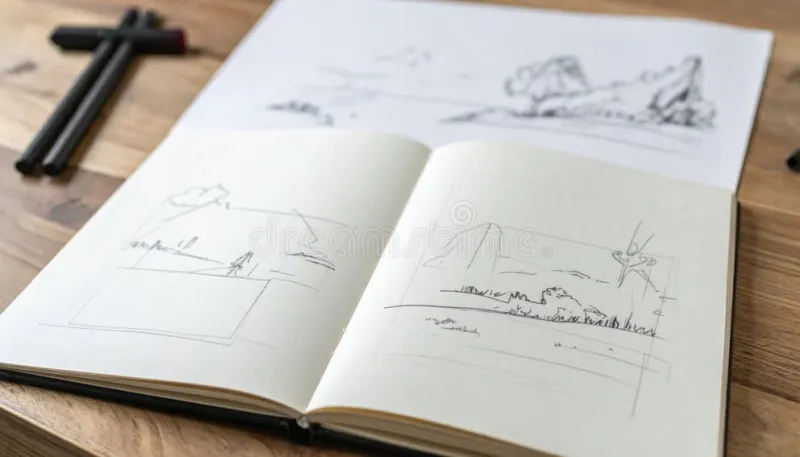
Photo by Photo by Kwami Fattah Al Sissi on Unsplash on Unsplash
The Notebook Page You Almost Ripped Out
There's probably a note somewhere in your phone — buried under grocery lists and random screenshots — that made complete sense when you typed it and absolutely zero sense now. Or maybe it's the opposite. You flip back through an old sketchbook or a dusty Google Doc and find something that felt throwaway at the time, and suddenly it's the most interesting thing you've seen in months.
That's not nostalgia. That's not selective memory. That's something a little more interesting happening in your creative brain.
Some ideas don't come out ready. They come out as signals — rough, incomplete, sometimes kind of awkward — and they need time, distance, and a different version of you to finally make sense. The creative instinct to immediately do something with an idea, or immediately decide it's garbage, is one of the most common ways we accidentally throw away our best material.
Why "Not Yet" Feels Like "Never"
We're wired to evaluate fast. You get an idea, you run it through a quick mental filter — is this good? Is this doable? Does this fit where I am right now? — and you make a call. Most of the time, that filter is working with incomplete information.
The version of you who had the idea was operating in a specific context. Specific mood, specific season, specific set of influences and pressures. When the idea doesn't immediately click into place, it's easy to assume the idea is the problem. But sometimes the timing is the problem. Sometimes you're the problem — not in a harsh way, just in a "you haven't lived enough of the story yet" kind of way.
Psychologists talk about something called the "incubation effect" — the documented phenomenon where stepping away from a problem actually leads to better solutions than grinding through it. Your brain keeps processing in the background even when you've moved on. It cross-references. It makes unexpected connections. It does a lot of its best work when you're not hovering over it demanding results.
The same thing happens with ideas over longer stretches of time. The concept that felt thin in 2021 might be exactly right in 2025 — because you've had experiences since then that give it weight, context, or a completely different interpretation.
The Idea Isn't Changing. You Are.
Here's the part that's easy to miss: the idea itself stays the same. What changes is your capacity to receive it.
Maybe you wrote down "something about grief and color" two years ago and it felt vague and unworkable. Then you went through something hard. Or you saw an exhibition that cracked something open. Or you just got older and a little more comfortable sitting with difficult material. Now that same vague phrase is a doorway instead of a dead end.
Creative people talk a lot about generating ideas — the brainstorming, the ideation, the constant churn of new concepts. But there's not nearly enough conversation about receiving ideas at the right moment. About having the patience to let something sit until you're actually equipped to do it justice.
This is especially true for the ambitious, slightly terrifying ideas. The ones that feel too big, too personal, or too weird for where you currently are. Those aren't bad ideas. They're advanced ideas. And the gap between you and them might just be time.
Building a System That Doesn't Let Good Ideas Die
If you're the kind of person who generates a lot of ideas but rarely returns to them, it's worth thinking about how you store and revisit your creative raw material.
A few things that actually help:
Date everything. Seriously. When you write down an idea, note when you wrote it. This gives you context later — you can see what season of your life it came from, and that context often unlocks meaning you couldn't see at the time.
Schedule returns. Build in a recurring habit of going back through old notes, sketchbooks, or idea files. Not to do something with everything you find, but just to look. A monthly or quarterly review takes maybe twenty minutes and consistently surfaces things worth revisiting.
Stop rating ideas at the moment of capture. The impulse to immediately sort ideas into "good" and "bad" piles is understandable, but it's often premature. Capture first. Evaluate later — much later, ideally with fresh eyes and a different headspace.
Let some ideas be placeholders. Not every idea needs to become a project. Some of them are just markers — little flags your brain planted in the ground that say something is here, come back when you're ready. That's a legitimate function. Not everything has to resolve.
The Creative Case for Sitting on It
There's a cultural pressure in creative work — especially now, when everyone is producing content at an industrial pace — to move fast. To post, publish, ship, and keep the machine running. And sure, momentum matters. Execution matters. You can't sit on everything forever waiting for perfect conditions that never arrive.
But the pendulum has swung pretty hard in the direction of speed, and it's worth asking what we're losing in the rush. Some of the most resonant creative work comes from ideas that had time to develop in the background — that got lived with, questioned, set aside, and eventually returned to with a whole new set of tools.
The waiting period isn't wasted time. It's development time. It's the period when an idea moves from concept to inevitability — when you stop asking "could I do this?" and start asking "how do I do this justice?"
That shift is everything. And it almost always requires patience you didn't know you were capable of.
Give the Slow Burn Its Due
Not every creative breakthrough announces itself loudly. Some of them are quiet, slow accumulations — an idea that's been composting in the back of your mind for years, quietly getting richer and more complex until one day it surfaces and you realize it's been ready for a while. You just needed to be ready too.
So before you write off that half-formed thing in your notes, the concept that never quite clicked, the project that felt premature — consider that you might just be in the middle of the waiting period. And the waiting period, uncomfortable as it is, might be exactly where the work needs to be right now.