Your Old Sketchbooks Are Calling — And This Time, You're Finally Ready to Pick Up
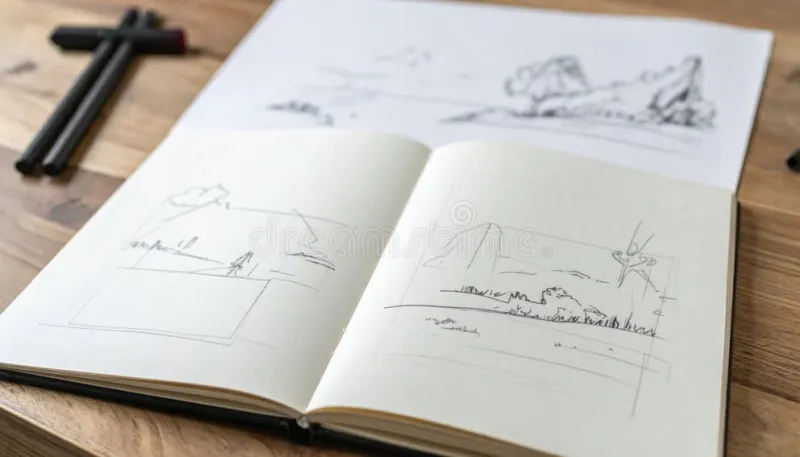
Photo: open vintage sketchbook with drawings on wooden desk, via thumbs.dreamstime.com
Somewhere in your apartment — maybe in a drawer you don't open, maybe in a box that survived your last move — there's a sketchbook, a notes app folder, a voice memo, or a Google Doc with a title like "idea maybe??" that you haven't thought about in years.
And here's the thing: it's probably better than you remember.
Not because past-you was secretly a genius. But because you've grown enough in the meantime to finally see what was actually there.
Why Timing Is a Creative Variable We Rarely Talk About
We tend to think about creativity as a linear process — you have an idea, you execute it, you move on. But a lot of artists, writers, and makers quietly know that some ideas just aren't ready when they show up. The concept is there, but the skill, the emotional context, the right medium, the moment — none of it has caught up yet.
So the idea gets shelved. Not abandoned, exactly. Just... waiting.
This isn't a failure of follow-through. It's actually how creative work operates more often than anyone admits. The musician who writes a lyric fragment in 2018 and doesn't know what to do with it until 2024. The painter who sketches a composition that feels off, then revisits it three years later and immediately understands what it needed. The novelist who cuts an entire chapter, saves it in a folder called "maybe someday," and eventually realizes it was always the real beginning.
Timing is a creative variable. We just don't give it nearly enough credit.
What Growth Does to Your Perception of Old Work
When you look at something you made years ago, you're not just seeing the work — you're seeing it through every skill, experience, and hard-won understanding you've accumulated since. That's a completely different set of eyes.
Old work that once felt clumsy might now read as raw and honest. A concept that seemed half-baked might suddenly reveal a structural logic you weren't equipped to recognize before. An abandoned project might have been missing exactly one thing — a technique you've since learned, a perspective you've since developed, a collaborator you've since met.
Your growth as a creator doesn't just move you forward. It also reshapes what you can see when you look backward.
This is why so many artists describe the experience of revisiting old work as almost eerie — like receiving a message from a previous version of themselves that somehow knew something they didn't. It's less about nostalgia and more about finally having the translation skills to read what was already written.
The Permission to Cannibalize Your Own Archive
There's a weird cultural pressure in creative spaces — especially online — to always be generating something new. Fresh content, new projects, original ideas. Starting from scratch gets framed as the default, and anything else can feel like cheating or recycling.
But that framing ignores something important: your archive is yours. You made it. You earned it. Mining it isn't laziness — it's resourcefulness.
Some of the most interesting creative work happens when someone gives themselves explicit permission to go back and pick up what they left behind. Not to reproduce it exactly, but to bring their current self into conversation with their past self. To take a sketch and reimagine it with everything they know now. To take a shelved idea and let it collide with the person they've become.
That collision is where the interesting stuff lives.
If anything, starting from your archive is often harder than starting from zero — because you have to hold two versions of yourself at once. The one who made the original thing and the one who's deciding what it becomes.
How to Actually Dig Through Your Own Stuff Without Spiraling
Okay, real talk: going through old work can be a trip. Some of it will make you cringe. Some of it will make you inexplicably sad for the person who made it. Some of it will feel completely foreign, like it was made by someone you no longer recognize.
All of that is fine. That's just the texture of having a creative history.
A few things that make the process more useful than overwhelming:
Go in with low stakes. You're not looking for a masterpiece. You're looking for a spark — one thing that creates a flicker of interest or curiosity or "huh, that's actually interesting." You only need one.
Separate the concept from the execution. A lot of old work fails at the execution level but has a genuinely strong idea underneath. Try to see past the craft limitations of your past self and ask: what was I actually trying to do here? Is that still interesting?
Let yourself steal from yourself freely. A color palette you used once. A structural idea you tried and abandoned. A character you never developed. A line of writing that didn't fit anywhere. These are all fair game. You don't owe your past self fidelity — you owe your current work the best possible ingredients.
Note what still feels charged. Some old work will feel completely dead to you — no energy, no pull, nothing. Other pieces will feel weirdly alive, even if you can't articulate why. Follow the alive ones. The charge is information.
The Resurrection Is Actually About You, Not the Work
Here's the part that tends to catch people off guard: when you return to an old project and suddenly see its potential, the revelation isn't really about the work. The work hasn't changed. You have.
Revisiting your archive is, in a strange way, one of the clearest mirrors you have for your own creative development. What you couldn't finish then, you might be able to finish now — not because the idea got better, but because you did. What felt inaccessible or overwhelming might now feel like exactly the right level of challenge.
That's worth paying attention to. Not just as a source of new material, but as a kind of ongoing check-in with where you actually are as a maker.
So if you've got a box in your closet, a folder on your desktop, or a voice memo from 2019 that you've been meaning to listen to — maybe this is the nudge. Go look. Go listen. Go read.
Your past self left you something. And you might finally be ready for it.